
Clara Schumann was trained from the age of 5 with her father, the well-known piano pedagogue Friedrich Wieck. Prior to beginning her lessons, young Clara had only uttered her first words some time between 4 and 5 years old. In fact, she described herself as understanding as little as she spoke and as having disinterest in all that was passing … [Read more...]
September 13 in German History
September 13, 1819 Birth of Clara Schumann in Leipzig, Germany. Schumann was a composer and the outstanding pianist of her century. Born Clara Wieck, she married the composer Robert Schumann in 1840 and took his name. The couple had 8 children. Clara and Robert were close friends with Johannes Brahms. September 13, 1872 Death of Ludwig … [Read more...]
September 12 in German History
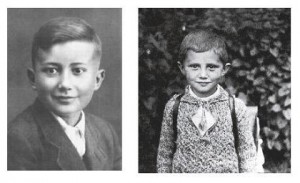
September 12, 1683 Austrian, Polish and German troops successfully defend Vienna and defeat the attacking Turks. The Austrian commander in chief is Karl IV Leopold. September 12, 1739 Death of Reinhard Keiser in Hamburg, Germany. An early composer of operas, his style starts with Baroque and ends with Rococo. He studied music in Leipzig … [Read more...]
September 11 in German History

September 11, 1227 Death of St. Ludwig IV von Thüringen (1200-1227). Ludwig IV has never been formally canonized but has been regarded locally as a saint since shortly after his death. He led a pious life and was a good duke in Thuringia. He is remembered primarily due to the holiness of his wife, the very popular St. Elisabeth von Thüringen. … [Read more...]
Bienenstich – German Bee Sting Cake
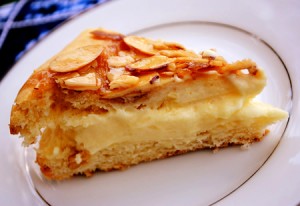
Bienenstich or Bee sting cake is a German dessert made of sweet yeast dough with a baked-on topping of caramelized almonds and filled with a vanilla custard, Buttercream or cream. The cake may have earned its name from its honey topping: according to one legend, a bee was attracted to it, and the baker who invented the cake was … [Read more...]
Zwetschgenkuchen (German Plum Cake)
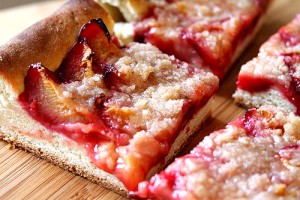
Zwetschgenkuchen is a traditional fresh plum cake, thought to have originated in the town of Augsburg, Germany. It is made with fresh prune plums which are at their peak in late summer. Perfect for the afternoon coffee hour. Serve at room temperature, with a dollop of fresh whipped cream. Ingredients: 1/2 cup butter, room temperature 1/2 cup … [Read more...]
The King’s Treat (Kaiserschmarrn)
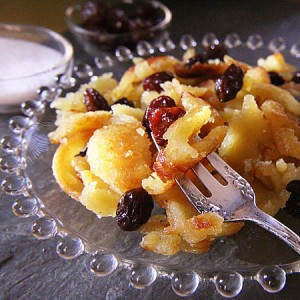
The name of the dessert (Kaiserschmarrn, or Emperor’s mess) came from the Emperor's wife, Elisabeth, who was obsessed with maintaining her waistline, directed the royal chef to prepare only light desserts. Upon being presented with the chef’s confection, she found it too rich and refused to eat it. The exasperated emperor quipped, “Now let ME see … [Read more...]
Apple Strudel (Apfelstrudel)

Few desserts embody Old World charm like Apfelstrudel, or Apple Strudel. With its paper-thin layers of flaky pastry wrapped around a sweet apple filling, Apfelstrudel is one of Germany’s most iconic desserts (with deep Austrian roots). It's the kind of dish that demands attention—not just when it’s on your plate, but when it’s being made, stretched … [Read more...]
Sauerkraut Recipes
Sauerkraut is probably the most well known German food. Sauerkraut is finely sliced green cabbage that has been fermented by lactic acid bacteria. The fermentation process (also known as pickling) gives the cabbage a distinct sour flavor, which is where it gets the name Sauerkraut (sour cabbage). In Germany, sauerkraut is often flavored with … [Read more...]
September 10 in German History

September 10, 1855 Birth of Robert Koldewey in Blankenburg am Harz, Germany. Koldewey was an archeologist who found the remains of the city of Babylon in southern Iraq. He began digging on March 26, 1899, and continued to work there with little interruption for the next 18 years. One of Koldewey’s most dramatic discoveries was the foundation of … [Read more...]
- « Previous Page
- 1
- …
- 101
- 102
- 103
- 104
- 105
- …
- 163
- Next Page »