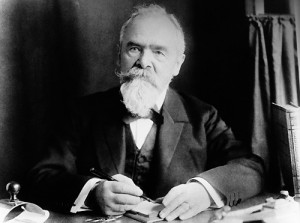
June 11, 1842 Birth of Carl von Linde in Berndorf, Germany. He was a German engineer who developed refrigeration and gas separation technologies. Linde's first refrigeration system used Dimethyl ether as the refrigerant and was built by Maschinenfabrik Augsburg (now MAN AG) for the Spaten Brewery in 1873. He quickly moved on to develop more … [Read more...]
June 10 in German History
June 10, 1051 Death of St. Bardo in Paderborn, Germany. Bardo was a Benedictine monk in Fulda. He later became the abbot at the monasteries in Kaiserswerth and Hersfeld. In 1031 he became the Archbishop of Mainz. He was known for his piety and gentle nature. It was he who constructed the present Cathedral of Mainz. He died on a visit to … [Read more...]
June 9 in German History
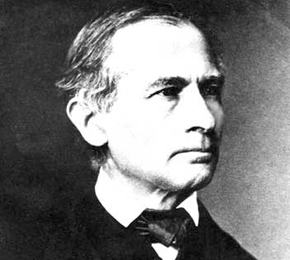
June 9, 1640 Birth of Leopold I in Vienna. As Emperor of the Holy Roman Empire he brought Austria to a position of influence. June 9, 1775 Birth of Georg Friedrich Grotefend in Münden, Germany. Grotefend made the first major breakthrough in the deciphering of ancient Persian cuneiform script. June 9, 1810 Birth of Otto Nicolai … [Read more...]
German Political Parties
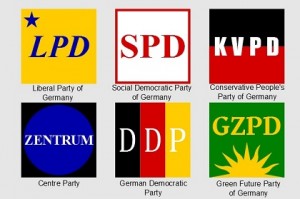
Observers often describe political parties as critical stabilizing institutions in democratic systems of government. Because of the central role played by German political parties, many observers refer to Germany as a "party state." The government of this type of state rests on the principle that competition among parties provides for both popular … [Read more...]
Electoral System of Germany

The Basic Law guarantees the right to vote by secret ballot in direct and free elections to every German citizen eighteen years of age or older. To be eligible to vote, an individual must have resided in a constituency district for at least three months prior to an election. Officials who are popularly elected include Bundestag deputies at the … [Read more...]
Bundesrat of Germany
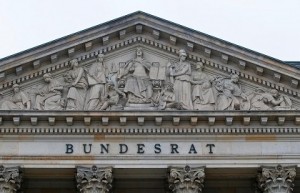
The second legislative chamber, the Bundesrat, is the federal body in which the sixteen Land governments are directly represented. It exemplifies Germany's federalist system of government. Members of the Bundesrat are not popularly elected but are appointed by their respective Land governments. Members tend to be Land government ministers. The … [Read more...]
German Bundestag
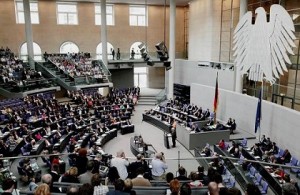
The Bundestag is the principal legislative chamber, roughly analogous to the United States House of Representatives. The Bundestag has grown gradually since its creation, most dramatically with unification and the addition of 144 new representatives from eastern Germany, for a total of 656 deputies in 1990. A further expansion in 1994 increased the … [Read more...]
The Legislature in German Politics
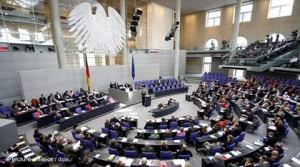
The heart of any parliamentary system of government is the legislature. Germany has a bicameral parliament. The two chambers are the Bundestag (Federal Diet or lower house) and the Bundesrat (Federal Council or upper house). Both chambers can initiate legislation, and most bills must be approved by both chambers, as well as the executive branch, … [Read more...]
The President in Germany
Presidents of the Federal Republic of Germany, 1949- President Years in Office Former Party Affiliation Theodor Heuss 1949-59 FDP Heinrich Lübke 1959-69 CDU Gustav Heinemann 1969-74 SPD Walter Scheel 1974-79 FDP Karl Carstens 1979-84 CDU Richard von Weizsäcker 1984-94 CDU Roman … [Read more...]
The Chancellor of Germany
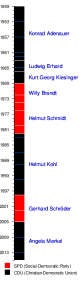
The federal government consists of the chancellor and his or her cabinet ministers. As explained above, the Basic Law invests the chancellor with central executive authority. For that reason, some observers refer to the German political system as a "chancellor democracy." The chancellor's authority emanates from the provisions of the Basic Law and … [Read more...]
- « Previous Page
- 1
- …
- 115
- 116
- 117
- 118
- 119
- …
- 163
- Next Page »