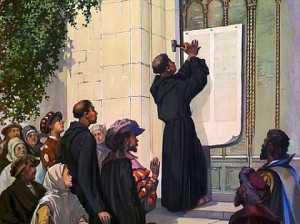
October 31, 994 Death of St. Wolfgang (924 – 994) St. Wolfgang was born in Pfullingen, Germany (in the modern state of Baden-Württemberg) in 924 to a noble family. He studied at the monastic school of Reichenau and the cathedral school of Würzburg. In 956 he became a teacher at the cathedral school of Trier. He entered the Benedictine order in … [Read more...]
October 30 in German History

October 30, 1466 Death of Johann Fust, a financial backer of Johannes Gutenberg. October 30, 1882 Birth of Günther von Kluge in Posen, Germany (now Poland). Kluge was a WWII German general who fought in Russia from 1941-1943 and replaced von Rundstedt on the Western Front in 1944. Suspected of being involved in the assassination attempt on … [Read more...]
October 29 in German History
October 29, 1268 Death of Konradin (Konrad der jüngere) in Naples, Italy (born in Wolfstein, Germany). The Swabian, Konradin, who held the title "king of the Romans" was the last of the Hohenstaufen dynasty. His downfall came in a conflict with the Frenchman, Charles of Anjou. After losing in battle and being captured, he was beheaded in the … [Read more...]
October 27 in German History

October 27, 1920 The League of Nations establishes its headquarters in Geneva, Switzerland. October 27, 1943 Death of Isidor Traube in Edinburgh, Great Britain (born in Hildesheim, Germany). Traube was a physical chemist at the Technische Hochschule, Berlin until 1939 when he immigrated to Great Britain and took a post at the … [Read more...]
October 26 in German History
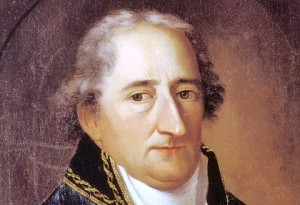
October 26, 1564 Birth of Hans Leo Hassler in Nürnberg, Germany. The composer, Hassler, was a leading musician of his times. In 1585 he became organist for the Fugger family in Augsburg, in 1600 director of music for Augsburg, in 1601 music director for Nürnberg and in 1608 organist for the elector of Saxony. October 26, 1576 Death of … [Read more...]
October 24 in German History

October 24, 1273 Rudolf I is crowned in Aachen as the German King. October 24, 1648 The final Treaty of Westphalia is signed, ending the Thirty Years War (1618-1648). The Peace of Westphalia was a series of peace treaties signed between May and October 1648 in Osnabrück and Münster. These treaties ended the Thirty Years' War (1618–1648) in … [Read more...]
October 23 in German History

October 23, 1705 Birth of Maximilian Reichsgraf Browne in Basel, Switzerland. Browne was an Austrian field marshal during the War of Austrian Succession (1740-1748) and The Seven Years' War (1756-1763). October 23, 1801 Birth of Albert Lortzing in Berlin, Germany. Lortzing was a composer who worked with the light opera. Titles by … [Read more...]
October 22 in German History
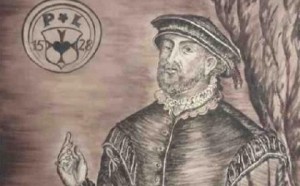
October 22 Feast Day of St. Cordula Little is known of St. Cordula who was a very early Christian in Cologne. She is said to have been a member of the following of St. Ursula. She is believed to have been martyred by the invading Huns. Her relics are in a shrine in the Johanniterkirche in Cologne. St. Albertus Magnus spoke of her as a saint … [Read more...]
October 21 in German History
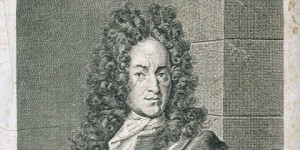
October 21, 1660 Birth of Georg Ernst Stahl in Ansbach, Germany. He was one of the first professors in the newly founded school of medicine in Halle in 1694. In the debates of the time Stahl opposed a purely mechanical view of the nature of life and adopted the philosophy of animism (an abstract principle of life). He hypothesized that all … [Read more...]
October 20 in German History
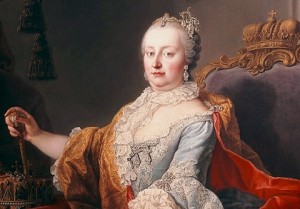
October 20, 1740 Maria Theresa assumes the rule of Austria, Bohemia and Hungary upon the death of her father Karl VI. Maria Theresa von Habsburg was one of the most remarkable rulers in European history. When her father died in 1740, she came to the Habsburg throne. She was young, amiable but oversheltered, and her father had amazingly neglected … [Read more...]
- « Previous Page
- 1
- …
- 95
- 96
- 97
- 98
- 99
- …
- 163
- Next Page »