
Roman Catholicism, one of Germany's two principal religions, traces its origins there to the eighth-century missionary work of Saint Boniface. In the next centuries, Roman Catholicism made more converts and spread eastward. In the twelfth and thirteenth centuries, the Knights of the Teutonic Order spread German and Roman Catholic influence by force … [Read more...]
June 5 in German History
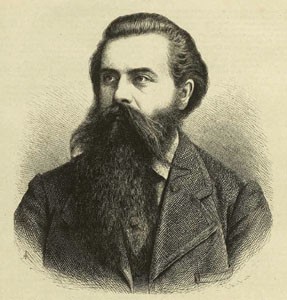
June 5, 755 St. Boniface is martyred. St. Boniface (Wynfrith) was an English monk who was appointed by the Pope as Bishop in 722 and sent to christianize Germany. In 745 his diocese was established in Mainz. He was killed by a pagan mob on June 5, 754. June 5, 755 St. Adalar is martyred. St. Adalar was an associate of St. Boniface. He was … [Read more...]
Structure of German Society
Most of the workforce is employed in the services sector. West Germany completed the transition from an industrial economy to one dominated by the services sector in the 1970s, and by the late 1980s this sector employed two-thirds of the workforce. In contrast, when the Berlin Wall fell, East Germany still had not made this transition. Because more … [Read more...]
June 4 in German History

June 4, 1697 Birth of Jocob Israel Emden in Altona, Germany. A Talmudic scholar whose disagreements with Rabbi Jonathan Eybesch split European Jewry. June 4, 1875 Death of Eduard Mörike in Stuttgart, Germany. Mörike was one of the greatest German lyric poets. He also wrote novels and novellas. His best known novella is Mozart auf der Reise … [Read more...]
June 3 in German History
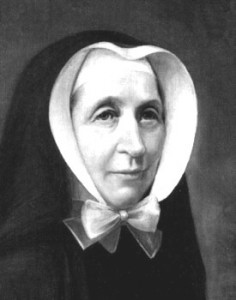
June 3, 1817 Pauline Mallinckrodt (1817-1881) was born in Minden, Germany, on June 3, 1817. She directed the institution for the blind in Paderborn, Germany. She founded the Congregation of the Sisters of Christian Charity on August 21, 1849. That order took charge of the school for the blind and established 20 additional houses in Germany. … [Read more...]
June 2 in German History

June 2, 1863 Birth of Felix Weingartner in Zara, Austrian Empire (now in Croatia). Weingartner was a composer and conductor. He studied with Franz Liszt at Weimar and at the conservatory in Graz, Austria. He conducted the Berlin Royal Opera in 1891. In 1907 he was appointed as Gustav Mahler's successor as conductor of the Court Opera in Vienna. … [Read more...]
June 1 in German History
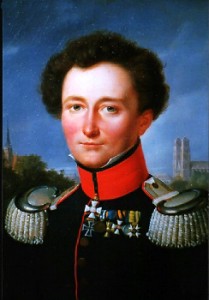
June 1, 1035 Death of St. Simeon. Simeon was born in Greece. He was educated in Constantinople. As a youth he lived and worked in the Holy Land. He lived for a number of years in monasteries in Bethlehem and in the Sinai preparing himself for the life of a hermit. He then moved to Trier (modern Germany, at that time the Holy Roman Empire a.k.a. … [Read more...]
Age-Gender Distribution in Germany
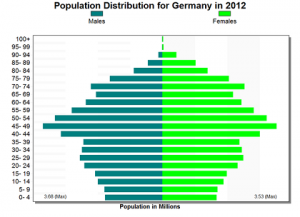
In the early 1990s, an age-gender distribution pyramid of unified Germany's population displayed at its apex the legacy of heavy war casualties: a preponderance of elderly women too great to be explained by women's greater longevity. Official statistics show that in 1990 there were approximately 2.7 million more females than males (41.2 million … [Read more...]
May 31 in German History
May 31, 1740 Death of Frederich Wilhelm I in Potsdam, Germany. Friedrich Wilhelm was the second king of Prussia. His policies developed Prussia into an efficient and powerful state. He married the daughter of Georg of Hannover (later to become George I, king of England). May 31, 1773 Birth of the romantic writer Ludwig Tieck in Berlin. … [Read more...]
May 30 in German History

May 30, 1527 The University of Marburg is founded. Philipps-Universität Marburg is not only a German university steeped in tradition, it is also the oldest university in the world that was founded as a Protestant institution in 1527. It has been a place of research and teaching for nearly five centuries. It was founded by Landgrave Philip I … [Read more...]
- « Previous Page
- 1
- …
- 118
- 119
- 120
- 121
- 122
- …
- 163
- Next Page »